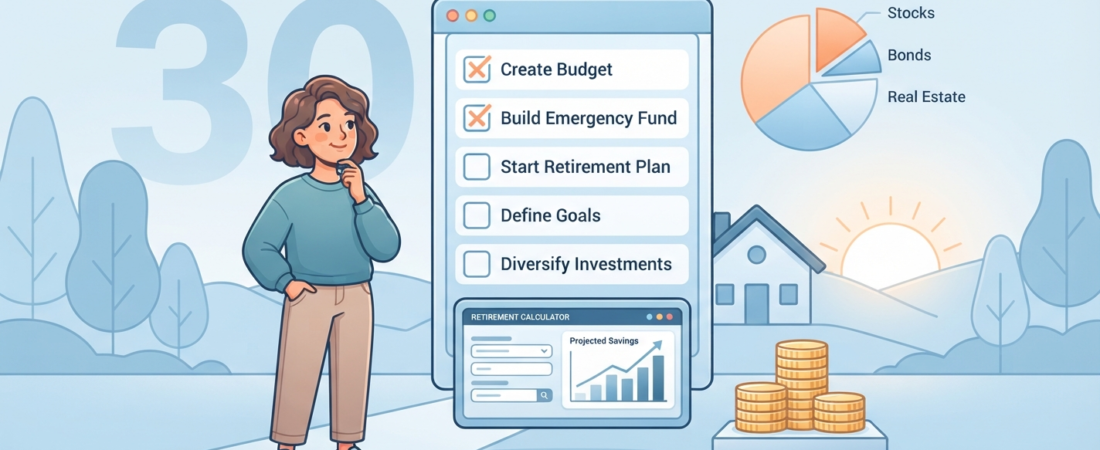
The math is simple: the earlier you start, the less you need to save each month to reach the same goal. This is the power of compound interest.
Here’s an example that always shocks people:
- If you start saving $500/month at age 25, and earn an average 7% annual return, you’ll have approximately $1.4 million by age 65.
- If you start at age 35, you’d need to save about $1,000/month to reach the same $1.4 million by 65.
Waiting 10 years doubled the monthly amount required. That’s the cost of delay.
In your 30s, you still have 25–35 years of investing ahead. That’s a massive advantage. But it also means every year you delay becomes more expensive. Retirement Planning in Your 30s
The takeaway: Your 30s are not the time to procrastinate. They’re the time to be intentional.
The #1 Rule of Thumb: Save 15% of Your Income
Financial experts, including Fidelity and many certified financial planners, widely recommend saving 15% of your gross income for retirement each year.
This includes:
- Your 401(k) contributions
- Employer match (yes, count it!)
- IRA contributions
- Any other retirement accounts
So if you earn $80,000 per year, you should be putting away $12,000 annually — or $1,000 per month — across all your retirement accounts.
But what if 15% feels impossible right now? That’s okay. Start with what you can — even 5% — and increase it by 1% every six months. Small, consistent increases add up faster than you think.
Benchmarks by Age: Are You on Track?
Another helpful way to measure progress is the age-based salary benchmarks Fidelity publishes. They’re simple to understand:
| Age | Multiple of Annual Salary Saved |
|---|---|
| 30 | 1x salary |
| 35 | 2x salary |
| 40 | 3x salary |
| 45 | 4x salary |
| 50 | 6x salary |
| 55 | 7x salary |
| 60 | 8x salary |
| 67 | 10x salary |
Let’s apply this to your 30s:
- At age 30: you should have saved your full annual salary. If you earn $60,000, you should have $60,000 saved.
- At age 35: you should have saved 2x your salary.
What if you’re already 35 and you have less than 2x? Don’t panic. These are guidelines, not iron laws. You can catch up by saving more than 15% in the coming years.
The 4% Rule and the “25x” Formula
To know exactly what number to target for retirement, the most popular method is the 4% rule.
The rule says: once you’re retired, you can safely withdraw 4% of your portfolio each year without running out of money over a 30-year retirement.
So, to figure out how much you need, multiply your desired annual retirement spending by 25.
Example:
- You want to spend $50,000 per year in retirement (in today’s dollars).
- You need: $50,000 × 25 = $1,250,000.
If you also expect Social Security to provide, say, $20,000 a year, you can subtract that from the required spending:
- Your portfolio needs to cover: $50,000 – $20,000 = $30,000 per year.
- Retirement savings target: $30,000 × 25 = $750,000.
This is a simplified version, but it gives you a tangible goal to work toward.
What If You’re Behind? (Realistic Catch-Up Strategies)
Let’s be honest: many people in their 30s haven’t hit those benchmarks yet. Life gets in the way — student loans, mortgages, kids, car payments.
If you’re behind, here’s your step-by-step catch-up plan:
1. Maximize Your Employer Match
If your company offers a 401(k) match, treat it as free money. Contribute at least enough to get the full match. That’s an immediate 50–100% return on your contribution.
For example, if your employer matches 5%, you should absolutely contribute 5% — even before paying off low-interest debt.
2. Automate Your Savings
Set up automatic transfers from your checking account to your retirement account on payday. If you never see the money, you won’t miss it.
3. Increase Your Contributions Each Year
Commit to raising your 401(k) or IRA contribution by 1% every six months. You’ll barely feel it, but your future retirement will thank you.
4. Redirect Windfalls
Tax refunds, bonuses, and side-hustle income belong in your retirement account. Next time you get a raise, “pay yourself first” by increasing your 401(k) contribution before you adjust your lifestyle.
5. Earn More with Passive Income
This is the part most retirement advice ignores: the best way to save more isn’t just cutting expenses — it’s increasing your income. The articles in this series can help:
- How to Make Money While You Sleep: Passive Income Blueprint →
- Building a Dividend Stock Portfolio →
- Creating Digital Products for Passive Revenue →
Every extra dollar you earn can flow directly into your retirement accounts.

The Right Accounts for Your 30s (401(k) vs IRA)
Choosing where to save is just as important as how much you save. Here’s a quick overview:
401(k)
- Offered by your employer
- Pre-tax contributions reduce your taxable income now
- Annual contribution limit for 2024: $23,000 (plus $7,500 catch-up if 50+)
- Employer match is usually available
- Limited to the investment choices your employer picks
Traditional IRA
- You open it yourself through a brokerage
- Contributions are tax-deductible (income limits apply)
- Annual limit for 2024: $7,000 (plus $1,000 catch-up if 50+)
- You choose your own investments
Roth IRA
- Contributions are made with after-tax money
- Qualified withdrawals in retirement are completely tax-free
- Annual limit: $7,000 (same as Traditional IRA)
- Income limits apply (single filers under $161,000; married couples under $240,000 for full contributions)
So which is better?
It depends on your tax situation. If you think your tax rate will be higher in retirement, a Roth IRA is better. If you think it will be lower, Traditional is better.
For most people in their 30s, a good strategy is:
- Contribute enough to your 401(k) to get the employer match.
- Then max out a Roth IRA.
- Then go back to your 401(k) and increase contributions.
I cover this in much more detail in my article 401(k) vs IRA: Which Retirement Account Is Better? → — definitely check that out next.
How Much Could You Actually Have by 65?
Let’s make this real. Here’s what different monthly contributions could look like at age 65, assuming a 7% average annual return (a reasonable long-term stock market average):
| Monthly Contribution (Starting at 35) | Savings at 65 |
|---|---|
| $200/month | $244,000 |
| $500/month | $612,000 |
| $750/month | $918,000 |
| $1,000/month | $1,224,000 |
| $1,500/month | $1,836,000 |
Note: This assumes a 25-30 year horizon and reinvested returns. Your actual results will vary based on market performance.
This table shows the magic of time and consistency. Even $200/month starting at 35 grows to a quarter of a million dollars.
Don’t Forget the Other Half of the Story: Retirement Expenses
The amount you need to save isn’t just about income — it’s about expenses. Often, 30-somethings underestimate what their retirement lifestyle will cost.
Consider these potential expenses:
- Housing (paid-off mortgage vs rent)
- Healthcare (which can get expensive as you age)
- Travel and leisure
- Supporting children or grandchildren
- Home repairs and vehicle replacements
- Long-term care (if needed)
A more accurate retirement number:
Start with your current annual expenses. In retirement, you may not need 100% of that — many experts estimate 70–80% — but it’s a solid starting point.
Example:
- Current annual expenses: $60,000
- 75% of that: $45,000
- Subtract Social Security: $18,000
- Portfolio must provide: $27,000
- Savings needed: $27,000 × 25 = $675,000
This gives you a personalized goal rather than a generic one.
Social Security: Will It Be There?
A common question is: “Will Social Security still exist when I retire?”
The Social Security Trust Fund is projected to be able to pay full benefits until around 2035. After that, if no changes are made, it may only pay about 80% of benefits. However, lawmakers from both parties regularly propose solutions.
The safest approach? Don’t rely on Social Security as your primary source. Treat it as a bonus, not a foundation.
I explain how to maximize your benefits in my article: Social Security Benefits: Maximizing Your Retirement Income →
A Sample Retirement Plan for Someone in Their 30s
Let’s put it all together with a practical example.
Meet Sarah, age 32.
- Annual salary: $75,000
- Current 401(k) balance: $35,000
- Employer match: 5% of salary
- Targeted retirement age: 65
- Desired retirement income: $50,000/year (in today’s dollars)
- Estimated Social Security: $20,000/year
What Sarah does:
- Contributes 5% to her 401(k) to get the employer match ($3,750/year + $3,750 match = $7,500/year total).
- Opens a Roth IRA and contributes the max $7,000/year.
- Sets up automatic monthly transfers to fund the Roth IRA ($583/month).
- Plans to increase her 401(k) by 1% every year until she reaches 15% total.
Projected outcome:
- Total annual contributions (after her increases): roughly $15,000–$20,000 by age 35.
- Assuming 7% returns, Sarah’s projected total at 65 is over $2.2 million.
She’ll have more than enough to retire comfortably.
Common Mistakes to Avoid in Your 30s
Even smart, financially aware people make these retirement planning mistakes. Let me help you avoid them.
1. Saving Cash Instead of Investing
Keeping all your savings in a bank account earns 4% at best. Over 30 years, that’s far less than the 7–10% historical average of a diversified stock portfolio.
The fix: Keep an emergency fund of 3–6 months in cash. Invest everything else for retirement.
2. Cashing Out or Borrowing from Your 401(k) When Changing Jobs
It’s tempting to use that old 401(k) to pay off debt or fund a down payment. But you’ll owe taxes plus a 10% early withdrawal penalty, and you’ll permanently lose decades of compound growth.
The fix: Roll your 401(k) into an IRA or your new employer’s plan.
3. Ignoring the Power of a Roth IRA
If you qualify for a Roth IRA, it’s one of the most powerful retirement tools. Tax-free growth and tax-free withdrawals are unbeatable.
The fix: If you’re eligible, open one and contribute before you spend on non-essentials.
4. Waiting Until You “Make More Money”
The truth is, most people’s spending rises with income. If you wait until your income is higher, you may still not save more. Build the habit now.
The fix: Save a percentage of every dollar you earn from now on.
5. Not Adjusting Your Plan as Life Changes
Marriage, kids, a new job, a raise — all of these change your financial picture. A plan you make at 30 won’t be the same plan you need at 40.
The fix: Review your retirement plan at least once a year, especially after major life events.
https://wealthytraders.online/401k-vs-ira/
https://wealthytraders.online/fire-movement-explained/
https://wealthytraders.online/social-security-benefits/
https://wealthytraders.online/estate-planning-basics/
Frequently Asked Questions
Is it too late to start saving for retirement at 35?
No. You still have 30+ years for compound interest to work. By saving 15–20% of your income, you can still build a comfortable nest egg.
What percentage of my income should I save for retirement in my 30s?
The widely recommended benchmark is 15% of your gross income, including employer match. If you’re behind, aim for 20–25% if possible.
Should I pay off debt before saving for retirement?
It depends on the interest rate. High-interest debt (8%+) should usually be prioritized. Low-interest debt (under 5%) can be balanced with retirement saving, especially if you’re getting an employer match.
How much will Social Security pay me?
You can create an account at ssa.gov to see your estimated benefits. The earlier you claim (age 62), the lower your monthly benefit. Delaying up to age 70 increases it significantly.
What if I have a gap in my savings (like from a career break)?
It’s not ideal, but it’s not fatal. You can compensate by saving more during your earning years or working a few years longer in your 60s.
Should I hire a financial advisor?
If you want a personalized plan, a fee-only fiduciary advisor can be worth the cost. But for most people, simple guidelines like the ones in this article are enough to get started.
Final Thoughts
Retirement planning in your 30s is all about consistent action, not perfection.
You don’t need to have everything figured out. You just need to:
- Know your target (the 25x rule helps).
- Save 15% (or work toward it).
- Use the right accounts (401(k) + Roth IRA).
- Automate your savings.
- Increase your contributions every year.
Maybe you’re on track. Maybe you’re behind. Either way, today is the best day to improve — and tomorrow is the second-best day.
The money you save now has decades to grow. That means every dollar you put away in your 30s is doing more work than three dollars you’ll save in your 50s.
So, take a deep breath. Open your brokerage app or 401(k) portal. Adjust your contribution by 1% today. That small click could be the difference between a retirement of abundance and one of uncertainty.
And if you want to build even faster, revisit the passive income ideas from earlier in this series:
- 15 Passive Income Ideas That Actually Work in 2024 →
- How to Make Money While You Sleep: Passive Income Blueprint →
- Dividend Stocks for Passive Income →
- Creating Digital Products →
- Rental Income 101 →
Your future, retirement-ready self will thank you.