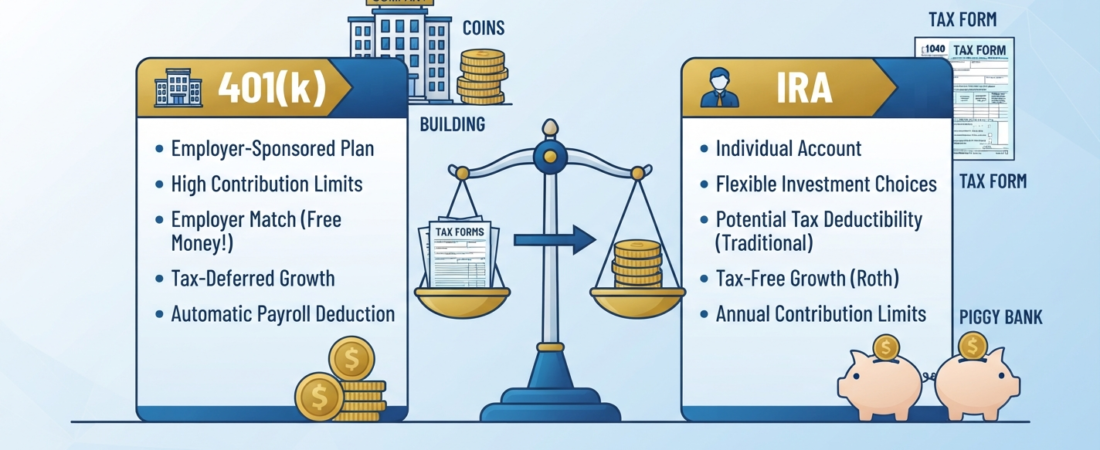
ou’re sitting in front of your computer, logged onto your 401(k) portal. You see the contribution slider and wonder: “Should I put more here? Or should I open an IRA instead? What’s the difference, really?”
It’s one of the most common questions in personal finance. And rightly so — choosing between a 401(k) and an IRA can significantly impact your retirement savings, your tax bill, and your future financial freedom.
Here’s the good news: you don’t have to choose one forever. In fact, for many people, using both is the smartest strategy.
https://wealthytraders.online/retirement-planning-in-your-30s/
In this guide, I’ll break down 401(k)s and IRAs side by side — explaining:
- What each account is and how it works
- The differences in contribution limits, taxes, and employer matches
- Why your employer match should always come first
- A simple rule to decide which to use next
If you’re working on building a complete financial life, this article pairs perfectly with my Retirement Planning in Your 30s: How Much Should You Save? → guide, where I cover saving benchmarks and retirement targets.
Let’s dive in.
Why the Account Type Matters So Much
Before we compare, let’s make one thing clear: the account matters almost as much as the investments inside it.
Two people could invest in the exact same stock market fund, but one uses a 401(k) and the other uses a Roth IRA. Over 30 years, their tax bills in retirement could be dramatically different.
The account you choose determines:
- When you pay taxes (now or in retirement)
- How much you can contribute each year
- Whether you get free money from an employer
- What investment options you have
- Whether you face penalties for early withdrawals
So choosing the right account is a cornerstone of retirement planning.
401(k) vs IRA at a Glance
Here’s a quick reference table you can save for later:
| Feature | 401(k) | IRA (Traditional or Roth) |
|---|---|---|
| Who offers it | Employer (sometimes self-employed) | You open it yourself at a brokerage |
| 2024 Contribution Limit | $23,000 (plus $7,500 catch-up if 50+) | $7,000 (plus $1,000 catch-up if 50+) |
| Employer Match | Usually available (free money!) | Not available |
| Tax Break | Pre-tax (Traditional) or Roth option in some plans | Traditional (pre-tax) or Roth (after-tax) |
| Investment Choices | Limited to your employer’s plan options | Almost unlimited (stocks, ETFs, mutual funds, bonds, etc.) |
| Early Withdrawal Penalty | 10% before age 59½ (with some exceptions) | 10% before age 59½ (with some exceptions) |
| Required Minimum Distributions (RMDs) | Yes, starting at age 73 (Traditional) | Traditional: yes at 73; Roth: no |
What Is a 401(k)?
A 401(k) is a retirement account offered through your employer. You elect to contribute a percentage of your pre-tax salary (or post-tax for Roth 401(k)s), and your employer may match a portion of it.
Why You Should Love Your 401(k)
1. Free money from your employer
If your employer matches 5% and you contribute 5%, that’s an instant 100% return on your contribution, before any market gains. That’s the single best deal in personal finance.
2. High contribution limits
In 2024, you can contribute up to $23,000 — more than three times the IRA limit. That’s ideal if you want to save aggressively.
3. Automatic savings
The money comes straight out of your paycheck. You never see it, so you don’t spend it.
4. Pre-tax or Roth options
Most 401(k)s now offer a Traditional (pre-tax) and a Roth (post-tax) option, giving you flexibility.
The Downsides
- Limited investment choices — you can only pick from the funds your employer selects, which may have higher fees.
- High fees possible — some 401(k) plans have high administrative and fund fees that eat into returns.
- You can’t contribute without an employer — unless you have a solo 401(k) as a self-employed person.
What Is an IRA?
An IRA (Individual Retirement Account) is an account you open yourself at a brokerage like Fidelity, Charles Schwab, or Vanguard. You choose your own investments from the entire universe of stocks, bonds, ETFs, and mutual funds.
There are two main types:
Traditional IRA
- Contributions are tax-deductible now (if you meet income requirements).
- Money grows tax-deferred.
- You pay income tax on withdrawals in retirement.
- Required Minimum Distributions (RMDs) start at age 73.
Roth IRA
- Contributions are made with after-tax dollars.
- Money grows completely tax-free.
- Withdrawals in retirement are 100% tax-free.
- No RMDs — you can leave the money there forever.
Why IRAs Are Powerful
1. Total investment freedom
You can buy almost anything. Index funds, dividend stocks, REITs, even real estate (in a self-directed IRA). This flexibility can reduce fees and improve returns.
2. Tax-free growth (Roth IRA)
If you expect to be in a higher tax bracket in retirement, Roth IRAs are unbeatable — you’ll never pay tax on those gains again.
3. Low minimums
You can open an IRA with as little as $0 in some brokerages, and buy fractional shares of index funds.
4. Rollover power
When you leave a job, you can roll your 401(k) into an IRA and gain more control.
The Downsides
- Lower contribution limit — $7,000 in 2024 is the max.
- No employer match — you’re on your own.
- Income limits for Roth IRA — high earners may not qualify (though a “backdoor Roth” exists).
- https://wealthytraders.online/social-security-benefits/
The 401(k) vs IRA Showdown: Which Should You Choose?
Here’s the short answer, and it applies to the vast majority of people:
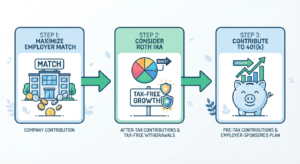
Prioritize your 401(k) up to the employer match. Then max out a Roth IRA. Then go back to the 401(k).
Let me explain why in a simple 3-step decision tree.
Step 1: Get the Full Employer Match First
If your employer matches a percentage of your 401(k) contributions, contribute at least enough to get 100% of that match.
Example: Your employer matches 5%. You contribute 5%. That’s free money. No other investment decision beats that return.
Step 2: Max Out a Roth IRA (if eligible)
Once you’ve captured the employer match, move to a Roth IRA. Why?
- Investment freedom — you can pick low-fee index funds.
- Tax-free growth and withdrawals — especially valuable if you’re in your 20s or 30s and have decades to compound.
- Lower fees than most 401(k) plans.
Step 3: Go Back to Your 401(k)
After maxing out a Roth IRA (or if you’re not eligible), increase your 401(k) contributions to the maximum allowed ($23,000 in 2024). You can also use a Traditional 401(k) or Roth 401(k) depending on your tax situation.
Why this order?
The employer match is free money, so it comes first. The Roth IRA beats the 401(k) for flexibility and tax-free growth, so it comes second. But the 401(k) has a much higher limit, so it comes third for aggressive savers.
Real-Life Example: Sarah’s Retirement Account Strategy
Let’s bring the decision to life with a relatable example.
Meet Sarah, age 30, salary $75,000.
Her employer offers a 401(k) with a 5% match. That means if she contributes 5%, the employer contributes an additional 5% — a total of 10% of her salary going to retirement.
What Sarah does first:
She contributes 5% to her 401(k) ($3,750/year) and gets $3,750 from her employer. That’s $7,500 per year — with a 100% return on her portion.
What Sarah does next:
She opens a Roth IRA and contributes the maximum $7,000 per year ($583/month). She invests it in a low-cost S&P 500 index fund.
What Sarah does after:
Since she wants to save more, she increases her 401(k) contribution by 1% every year until she reaches 10% of her salary.
Her projected outcome at age 65 (at 7% average returns):
- 401(k) with match: roughly $1.2 million
- Roth IRA: roughly $1.0 million
- Total: $2.2 million — with the Roth IRA portion completely tax-free.
That’s the power of using both accounts strategically.
Traditional vs Roth: The Big Tax Question
Whether you choose a 401(k), IRA, or both, you’ll also face the question: Traditional or Roth?
Here’s a simple way to decide:
- Traditional gives you a tax break now. Choose this if you expect to be in a lower tax bracket in retirement than you are today.
- Roth gives you tax-free withdrawals later. Choose this if you expect to be in a higher tax bracket in retirement than you are today.
For most people in their 30s and 40s, who are likely in their peak earning years and will have less reportable income in retirement, a Roth IRA is a powerful choice.
But many people diversify by having both Traditional and Roth accounts, giving them flexibility to manage tax brackets during retirement.
https://wealthytraders.online/estate-planning-basics/
401(k) vs IRA: Fees Matter More Than You Think
One overlooked difference: fees.
- Many 401(k) plans charge administrative fees of 0.5%–1.5% annually.
- Some plans include expensive funds with expense ratios above 1%.
- IRAs allow you to buy low-cost index funds with expense ratios of just 0.03%–0.20%.
Although a 1% difference might seem small, it can cost you six-figure amounts over a 30-year career.
Example: $50,000 invested over 30 years at 7% return
| Annual Fee | Balance after 30 Years |
|---|---|
| 0.05% | $104,412 |
| 0.50% | $101,071 |
| 1.00% | $97,291 |
So, if your 401(k) has high fees, an IRA is an even more attractive second step.
What About Rolling Over Your Old 401(k)?
If you changed jobs at some point, you might have an old 401(k) sitting at a previous employer. You have four options:
- Leave it there — possible but you’ll lose track of it and can’t control its fees.
- Roll it into your new employer’s plan — keeps everything in one place.
- Roll it into an IRA — gives you full investment control and low fees. This is often the best choice.
- Cash it out — avoid this at all costs. You’ll pay taxes plus a 10% penalty.
A rollover IRA is often the smartest move, but be careful with the rules — a direct rollover avoids taxes and penalties. I explain more in my Estate Planning Basics → article about protecting your financial future.
Common 401(k) and IRA Mistakes to Avoid
I’ve seen these mistakes ruin years of retirement progress. Learn from others’ pain.
1. Leaving Free Money on the Table
If your employer offers a match and you don’t take it, you’re literally turning down a guaranteed 50–100% return.
Fix: At minimum, contribute up to the full match amount.
2. Cashing Out a 401(k) When Changing Jobs
Many people do this when they switch jobs. The result is taxes + 10% penalty + lost decades of compounding.
Fix: Roll it into an IRA or your new 401(k) — never cash out.
3. Choosing Traditional Over Roth Without Thinking
Some people just pick whatever their employer defaults to. That can be a costly oversight.
Fix: If you’re young and likely in a lower tax bracket now than later, Roth is probably better.
4. Not Rebalancing Your Investments
Retirement accounts need occasional rebalancing to keep your risk level aligned with your age.
Fix: Once a year, rebalance your portfolio back to your target allocation (e.g., 80% stocks, 20% bonds).
5. Thinking You Can’t Open an IRA if You Have a 401(k)
You absolutely can! Having both is very common and usually a great idea. Just be aware of income limits for Roth IRA eligibility.
Frequently Asked Questions
Can I have both a 401(k) and an IRA at the same time?
Yes. Many people contribute to their 401(k) to get the employer match and also fund a Traditional or Roth IRA.
Which is better: a 401(k) or an IRA?
For most people, the 401(k) is better to the extent of the employer match because that’s free money. After the match, an IRA usually offers better investment options and lower fees.
Are 401(k) and IRA contributions combined for contribution limits?
No. Each account has its own separate contribution limit. That means you could contribute $23,000 to a 401(k) and $7,000 to an IRA in the same year.
How much does an employer typically match in a 401(k)?
The most common formula is a 50% match up to 6% of your salary, though many employers offer 100% up to 3–5%. Always check with your HR department.
What happens to my 401(k) when I switch jobs?
You can leave it with your old employer, roll it into your new employer’s plan, or roll it into an IRA. Rolling to an IRA often gives you the most control and widest investment choices.
Can I withdraw money from my 401(k) or IRA before age 59½ without penalty?
Yes, in some situations. The IRS allows penalty-free withdrawals for certain exceptions like a first-time home purchase ($10,000 limit for IRAs), disability, or certain medical expenses. Otherwise, you’ll pay a 10% penalty in addition to taxes.
What is a backdoor Roth IRA?
It’s a legal strategy for high earners who exceed Roth IRA income limits. You contribute to a Traditional IRA and then convert it to a Roth IRA. It’s a bit complicated, so consult a tax professional if you need it.
Final Thoughts
The 401(k) vs IRA debate isn’t really about choosing one. It’s about using each account to its strengths.
Here’s your action plan:
- Contribute enough to your 401(k) to get the full employer match.
- Open a Roth IRA and max it out (if you’re eligible).
- Go back to your 401(k) and increase contributions as much as possible.
- Review your investment fees and rebalance at least once a year.
This simple strategy can put you on the fast track to retirement security — and you don’t need to be a financial expert to do it.
If you haven’t yet read my Retirement Planning in Your 30s → guide, do that next to check your savings benchmarks. And if you’re interested in maximizing your Social Security in retirement, my article on Social Security Benefits → is waiting for you.
The power of compounding rewards those who start early and stay consistent. Your future self will thank you for every single dollar you set aside today.