Here’s a number that might surprise you:
The average retired worker in 2024 receives about $1,900 per month from Social Security. That’s roughly $22,800 per year.
For many people, that’s not enough to live on alone. But here’s the thing: it’s not supposed to be. Social Security is designed to replace only about 40% of your pre-retirement income. The rest is supposed to come from your own savings, pensions (if you have one), and investments.
But even with that 40% replacement, there’s a huge difference between claiming Social Security the “average” way and claiming it the smart way. Done right, you could increase your lifetime benefits by $100,000 or more — simply by making the right decisions at the right time.
https://wealthytraders.online/retirement-planning-in-your-30s/
In this guide, I’m going to walk you through the most effective strategies to maximize your Social Security benefits. You’ll learn:
- How your benefit is calculated
- The best age to claim (and why it matters so much)
- How spousal and survivor benefits work
- How taxes affect your benefits
- And the mistakes that cost retirees thousands
This article is part of your retirement planning journey. If you haven’t read Retirement Planning in Your 30s → yet, start there to understand the full picture. And if you’re exploring early retirement, check out my FIRE Movement Explained → article.
Let’s dive into the details and make sure you get every dollar you deserve.
How Social Security Benefits Are Calculated
To maximize your benefits, you first need to understand how they’re calculated. The Social Security Administration (SSA) uses a multi-step process:
Step 1: Average Indexed Monthly Earnings (AIME)
The SSA looks at your highest 35 years of earnings (adjusted for inflation). If you worked fewer than 35 years, zeros are added for the missing years. That drags your average down.
Key takeaway: Working at least 35 years is critical. Every year with zero earnings replaces a year of real earnings.
Step 2: Bend Points
Your AIME is then plugged into a formula with “bend points” — thresholds where the percentage of income replaced changes:
| Portion of AIME | Replacement Rate |
|---|---|
| First $1,174/month (2024) | 90% |
| Next $1,174 to $7,078/month | 32% |
| Above $7,078/month | 15% |
What this means:
- Low earners get a higher replacement rate.
- High earners get a lower replacement rate.
Step 3: Primary Insurance Amount (PIA)
The result is your PIA — the monthly benefit you’ll receive if you claim at your Full Retirement Age (FRA).
Your FRA depends on your birth year:
| Birth Year | Full Retirement Age |
|---|---|
| 1943–1954 | 66 years |
| 1955 | 66 + 2 months |
| 1956 | 66 + 4 months |
| 1957 | 66 + 6 months |
| 1958 | 66 + 8 months |
| 1959 | 66 + 10 months |
| 1960 or later | 67 years |
When Should You Claim Social Security?
The most important decision you’ll make is when to claim. It determines the size of your monthly check for the rest of your life.
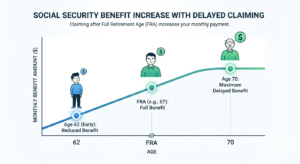
You can claim as early as age 62 and as late as age 70. Here’s how claiming age affects your benefit:
| Claiming Age | Effect on Your Benefit |
|---|---|
| Age 62 (earliest) | 70% of your PIA (if FRA is 67) |
| Age 63 | 75% |
| Age 64 | 80% |
| Age 65 | 86.7% |
| Age 66 | 93.3% |
| Age 67 (FRA) | 100% |
| Age 68 | 108% |
| Age 69 | 116% |
| Age 70 (max) | 124% |
In simple terms: For each year you delay past your FRA, you earn an 8% guaranteed increase. For each year you claim early, you lose about 6–7%.
What’s the “best” age?
It depends on your health, life expectancy, and financial situation. But here’s a useful rule:
If you expect to live past age 80, delaying is usually the better financial choice.
If you have health issues or a family history of shorter lifespans, claiming earlier may make more sense.
A common compromise strategy: claim at your FRA (full retirement age). That gives you 100% of your benefit without the risk of waiting too long.
Claiming Early: When It Makes Sense
- You need the income now.
- You have health issues that may shorten your lifespan.
- Your spouse has a much larger benefit and you’ll later switch to spousal/survivor benefits.
- You’ve lost your job and need cash flow to avoid tapping other retirement accounts.
Delaying: When It Makes Sense
- You’re healthy and likely to live into your 80s or 90s.
- You have other income to live on in your 60s.
- You want to maximize your survivor benefits for your spouse.
- You can afford to wait and want a guaranteed, inflation-adjusted income increase.
https://wealthytraders.online/401k-vs-ira/
The Spousal Benefit Strategy
Marriage can significantly affect your Social Security benefits. Here are the rules:
Spousal Benefits (While Both Spouses Are Alive)
- A spouse can claim a benefit equal to 50% of the higher-earning spouse’s PIA (at their full retirement age).
- If you claim early, the spousal benefit is reduced.
- The lower-earning spouse typically receives the higher of their own benefit or the spousal benefit.
Example:
- John’s PIA: $2,500/month
- Mary’s PIA: $800/month
Mary can claim her own $800, or she can claim a spousal benefit of $1,250 (50% of John’s $2,500). She’ll automatically get the higher amount.
Survivor Benefits (After One Spouse Passes)
- The surviving spouse receives the higher of the two benefits — but not both.
- If the higher earner delayed claiming, the survivor benefit is even larger.
- Widows/widowers can claim survivor benefits as early as age 60 (50 if disabled).
Strategy: If you’re the higher earner, delaying your claim can dramatically increase the survivor benefit your spouse will receive for the rest of their life. This could mean more than $100,000 in extra benefits over time.
Maximizing Both Spouses’ Benefits: A Common Strategy
- The higher earner delays until age 70 to maximize the benefit and survivor protection.
- The lower earner claims at their FRA (or earlier if needed) to bring money into the household sooner.
- Once the lower earner reaches FRA, they can switch to the spousal benefit if it’s higher.
This approach balances current income with lifetime maximization.
The Earnings Test (If You Work While Claiming Early)
If you claim Social Security before your FRA and continue to work, your benefits may be temporarily reduced:
- In 2024: If you’re under FRA for the whole year, $1 in benefits is withheld for every $2 you earn above $22,320.
- In the year you reach FRA: $1 in benefits is withheld for every $3 you earn above $59,520.
Good news: These withheld amounts are not lost. If you reach your FRA and continue to claim, your monthly benefit is recalculated upward to account for the months when benefits were withheld.
If you can, avoid claiming while still working — it’s like taking a pay cut on your retirement income.
How Social Security Is Taxed (Yes, It Is Taxable)
Many people are shocked to learn that Social Security benefits can be taxed. It depends on your “combined income”:
Combined income = Adjusted Gross Income (AGI) + Nontaxable Interest + ½ of your Social Security benefits.
| Filing Status | Combined Income | % of Benefits Taxed |
|---|---|---|
| Single | Under $25,000 | 0% |
| Single | $25,000 – $34,000 | Up to 50% |
| Single | Above $34,000 | Up to 85% |
| Married Filing Jointly | Under $32,000 | 0% |
| Married Filing Jointly | $32,000 – $44,000 | Up to 50% |
| Married Filing Jointly | Above $44,000 | Up to 85% |
Up to 85% of your Social Security benefits could be subject to federal income tax. Plus, states may also tax it.
How to Reduce Social Security Taxes
- Draw from Roth IRA accounts — Roth withdrawals don’t count toward combined income.
- Delay Social Security while using taxable or Roth funds in your 60s.
- Manage your investment income — avoid selling large gains in years when you have high Social Security income.
Divorce and Social Security: Know Your Rights
If you’re divorced, you may still be entitled to benefits based on your ex-spouse’s record:
- You must have been married for at least 10 years.
- You must be unmarried.
- You must be at least age 62.
- The benefit is equal to 50% of your ex-spouse’s PIA if you claim at your FRA.
Divorced Spouse Strategy:
- If your ex-spouse has a much higher benefit than you, it can be more advantageous to claim a spousal benefit on their record instead of your own.
- This doesn’t affect your ex-spouse’s benefits.
Important: Even if your ex-spouse hasn’t claimed yet, you can still claim a divorced spousal benefit if you’ve been divorced for at least 2 years and both of you are at least 62.
The “File and Suspend” and “Restricted Application” Strategies (What’s Left in 2024)
In the past, married couples used advanced strategies to triple their benefits. But the Bipartisan Budget Act of 2015 eliminated most of them.
What still exists:
- Restricted Application — only if you were born before January 2, 1954. If you qualify, you can claim only spousal benefits at FRA and delay your own retirement benefits until 70.
- File and Suspend — also eliminated for anyone born after April 30, 1950. Only those grandfathered in can use it.
The modern reality: Most people in their 30s and 40s today cannot use these advanced strategies. The simple “delayed claiming + spousal coordination” approach is the best available.
https://wealthytraders.online/fire-movement-explained/
Strategies for Maximizing Social Security: A Summary
Here are the actionable strategies you can implement starting today:
| Strategy | What to Do | Who It’s For |
|---|---|---|
| Delay Benefits to Age 70 | Wait until 70 to collect the maximum amount | Healthy individuals who can delay |
| Work 35+ Years | Ensure you have 35 full earning years | Anyone with gaps in work history |
| Coordinate with Spouse | Higher earner delays; lower earner claims earlier | Married couples |
| Coordinate Divorce Benefits | Use ex-spouse’s record if it gives you more | Divorced individuals |
| Minimize Taxable Income | Use Roth IRAs, tax-loss harvesting, or manage income | Anyone near the tax thresholds |
| Avoid Working While Claiming Early | Wait until FRA before claiming if still working | Working seniors |
Real-Life Case Study: How One Decision Can Add $100,000+
Let me show you the financial impact of a smart claiming strategy.
Meet Tom and Lisa, both age 62.
- Tom’s PIA at FRA (67): $2,800/month
- Lisa’s PIA at FRA: $1,200/month
- Both expect to live to age 90.
Strategy A (Claim Immediately at 62):
- Tom claims at 62: 70% × $2,800 = $1,960/month
- Lisa claims at 62: 70% × $1,200 = $840/month
- Total starting combined monthly: $2,800
- Combined lifetime benefits (ages 62–90): approximately $750,000
Strategy B (Tom delays; Lisa claims at 62):
- Tom delays until 70: 124% × $2,800 = $3,472/month
- Lisa claims at 62: $840/month
- Total starting combined monthly (at 70): $4,312, then Lisa switches to spousal (50% of Tom’s PIA = $1,400)
- Combined lifetime benefits (Lisa from 62, Tom from 70, both to 90): approximately $870,000
The difference: $120,000+ in lifetime income — just from Tom waiting 8 years.
Now imagine if both Tom and Lisa delayed. The difference grows even bigger.
How to Check Your Social Security Benefits Online
It’s easy to see what your benefit would be at different claiming ages:
- Create a my Social Security account at ssa.gov.
- View your full earnings record (and fix any errors!).
- See your benefit estimates at ages 62, FRA, and 70.
- Use the online calculators to try different claiming scenarios.
Important: Verify your earnings record every year. Social Security benefits are based on your lifetime earnings — if your record has missing or incorrect wages, your benefit could be reduced.

Common Social Security Mistakes to Avoid
These mistakes cost retirees thousands every year. Avoid them.
1. Claiming Too Early
If you claim at 62 and live to 90, you lose roughly 25-30% of your lifetime benefits compared to claiming at FRA. It’s the biggest and most common mistake.
Fix: Unless you have a clear need, delay claiming to at least your FRA.
2. Ignoring Spousal and Survivor Benefits
Hundreds of thousands of people never claim spousal benefits because they don’t know they exist. This is free money.
Fix: Understand the rules and coordinate with your spouse.
3. Not Working 35 Years
Every year under 35 adds a zero to your earnings history, dragging down your AIME.
Fix: If you’re under 35, commit to working at least this many years. If that’s impossible, don’t worry — Social Security drops your 5 lowest earning years, so longer work histories reduce zero-impact.
4. Claiming Benefits While Still Working (Before FRA)
Earnings test reduces your benefits. Though they’re recalculated later, it’s not a smart move unless you need the money.
Fix: Stop working before claiming if you can, or at least time claiming to avoid crossing thresholds.
5. Not Fixing Errors on Your Earnings Record
The SSA may have missing or incorrect earnings data. This reduces your benefit.
Fix: Check your Social Security statement every year and file corrections immediately.
6. Forgetting About Tax Implications
If you have high income in retirement, up to 85% of your Social Security benefits may be taxed.
Fix: Use Roth withdrawals and manage taxable income to minimize or eliminate taxes on your benefits.
Frequently Asked Questions
At what age should I claim Social Security?
If possible, claim at your Full Retirement Age (67 for those born in 1960 or later) or delay until age 70 for the maximum benefit. The best age depends on your health, income needs, and retirement goals.
Can I claim Social Security at 62 and still work?
Yes, but if you earn above the annual limit, your benefits will be temporarily withheld. When you reach FRA, your benefit is recalculated upward.
How much Social Security will I get?
The average monthly retirement benefit is about $1,900. To see your personal estimate, create a my Social Security account.
Can I claim spousal benefits if I never worked?
Yes, you can claim a spousal benefit up to 50% of your spouse’s PIA as long as you’ve been married for at least one year.
Are Social Security benefits really taxed?
Yes, anywhere from 0% to 85% of benefits can be taxable depending on your combined income. But you can manage withdrawals to minimize your tax bill.
Will Social Security run out before I retire?
The Trust Fund may be depleted by 2035, after which a reduction of roughly 20-25% could be required if no legislative changes are made. It’s wise to plan as if you’ll receive about 75% of your estimated benefits. That’s another good reason to build your own retirement savings.
How do I maximize my survivor benefit?
If you’re the higher earner, delay claiming until age 70. This ensures your spouse receives the largest possible benefit if you pass first.
Final Thoughts
Social Security is one of the most valuable retirement assets you’ll ever have — but only if you use it wisely.
A difference of a few years can mean $100,000 or more in lifetime benefits. So it’s absolutely worth your time to understand the system and plan your claiming strategy.
For most people, the best strategy is simple:
- Work at least 35 years
- Verify your earnings record
- Delay claiming at least to FRA if possible
- Coordinate with your spouse
- Minimize taxes with a smart withdrawal plan
And don’t forget: Social Security is just one piece of the retirement puzzle. Combined with your own savings, passive income, and smart tax planning, you can create a secure, comfortable retirement.
If you want to learn how to protect your assets and family for the long term, my Estate Planning Basics → article is your next step. And if you haven’t reviewed your retirement accounts, start with Retirement Planning in Your 30s →.
Now, log in to your Social Security account. Check your earnings record. And if you haven’t already, create a plan for your claiming age. Your future self will thank you.