
Introduction
You’ve decided to take the leap into freelancing. Maybe you’re tired of the 9-to-5 grind, need flexible income around family obligations, or simply want to monetize skills you already have. The appeal is clear: set your own schedule, choose your clients, work from anywhere, and keep 100% of what you earn.
But there’s one massive hurdle standing between you and freelance success: landing that first client.
Without a portfolio, testimonials, or proven track record, breaking into freelancing feels like an impossible catch-22. Clients want to hire experienced freelancers, but how do you gain experience without clients?
Here’s the truth that the “guru” courses won’t tell you: landing your first freelance client isn’t about having a perfect website, professional logo, or thousands of social media followers. It’s about understanding what clients actually want, positioning yourself strategically, and executing a proven outreach process.
https://wealthytraders.online/legitimate-side-hustles/
Over 59 million Americans freelanced in 2023, contributing $1.27 trillion to the U.S. economy. The market is massive and growing. There are clients actively searching for freelancers right now—including beginners who charge less than established professionals.
The difference between aspiring freelancers who never land a client and those earning their first $1,000 within 30 days comes down to following the right process and taking consistent action.
This comprehensive guide will walk you through everything you need to know to land your first freelance client. You’ll learn how to choose a marketable service, build a simple portfolio from scratch, set your rates strategically, find clients actively looking for help, craft proposals that get responses, and deliver work that leads to testimonials and referrals.Freelancing for Beginners.
No fluff. No theory. Just the exact steps that have worked for thousands of first-time freelancers.
For broader context on building income streams, check out: 25 Legitimate Side Hustles That Pay $500+ Per Month
Step 1: Choose Your Freelance Service
The first mistake beginners make is trying to be a “jack of all trades.” Clients don’t hire generalists—they hire specialists who solve specific problems.
The Most In-Demand Freelance Services
Writing and Content Creation
- Blog posts and articles ($50-$500+ per article)
- Website copy ($100-$2,000+ per project)
- Email marketing ($300-$1,500+ per campaign)
- Social media content ($200-$1,000+ per month)
- Technical writing ($75-$150+ per hour)
Design and Creative
- Logo design ($200-$2,000+)
- Social media graphics ($15-$100 per graphic)
- Website design ($500-$5,000+)
- Presentation design ($100-$500+)
- Illustration ($50-$500+ per illustration)
Digital Marketing
- Social media management ($500-$3,000+ per month)
- Facebook/Instagram ads management ($500-$2,500+ per month)
- SEO services ($500-$5,000+ per month)
- Email marketing management ($400-$2,000+ per month)
Web Development and Tech
- WordPress website setup ($500-$3,000+)
- Website maintenance ($100-$500+ per month)
- Custom web development ($50-$150+ per hour)
- App development ($5,000-$50,000+)
Virtual Assistance and Administrative
- General virtual assistant ($15-$40 per hour)
- Bookkeeping ($30-$60 per hour)
- Data entry ($10-$25 per hour)
- Project management ($40-$100 per hour)
How to Choose Your Service
Ask yourself three questions:
1. What skills do I already have?
Your fastest path to the first client leverages existing skills. If you write well, start with content writing. If you’re good with Excel, offer data services. If you have an eye for design and know Canva, start with social media graphics.
2. What can I learn quickly?
Some skills can be learned well enough to serve beginners-level clients in 2-4 weeks:
- Basic social media management
- Canva graphic design
- WordPress website setup
- Email marketing (using platforms like Mailchimp)
- Basic SEO
3. What’s in demand?
Check Upwork, Fiverr, and Freelancer.com. Search for services in your area of interest. If you see hundreds of job postings, there’s demand.
The beginner-friendly formula:
Choose a service that matches your current skills (even if basic), has clear demand, and can deliver tangible results for clients.
Example: “I’ll help small business owners create professional social media graphics using Canva” is better than “I do marketing.”
Step 2: Build a Portfolio (Even Without Clients)
“But I don’t have any work to show!” This is the most common objection, and it’s easily solved.
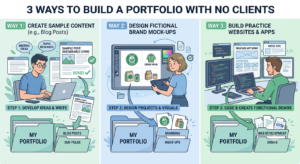
Creating Sample Work
You don’t need paying clients to create portfolio pieces. You just need examples that demonstrate your capability.
For Writers:
- Write 3-5 sample blog posts in your target niche
- Create sample website copy for fictional (or real) businesses
- Develop a case study format article
- Write social media captions for popular brands
For Designers:
- Redesign existing brands (before/after mock-ups)
- Create social media templates for specific industries
- Design mock website layouts
- Develop logo concepts for fictional companies
For Social Media Managers:
- Create a month’s worth of content calendar for a niche
- Design 10-15 graphics with captions
- Develop a sample social media strategy document
- Create engagement report templates
For Web Developers:
- Build 2-3 websites for fictional businesses
- Redesign existing websites (as mock-ups)
- Create functional templates
- Contribute to open-source projects (adds credibility)
The quality rule:
Create 3-5 pieces of your absolute best work. Better to have 3 excellent samples than 10 mediocre ones.
The Strategic Portfolio Structure
Your portfolio doesn’t need to be fancy. A simple, professional presentation works.
Minimum viable portfolio:
Option 1: Simple website
- Use free platforms: WordPress.com, Wix, Carrd, or Notion
- Homepage: Brief intro, your service, call-to-action
- Portfolio page: 3-5 best samples with descriptions
- About page: Your story, why you freelance, who you help
- Contact page: Email and booking calendar link
Option 2: Portfolio PDF
- Create a clean PDF showcasing your work
- Include brief descriptions of each project
- Add your contact information
- Host on Google Drive with public sharing link
Option 3: Platform profiles
- Create detailed Upwork/Fiverr profiles
- Upload sample work directly to these platforms
- Use their built-in portfolio features
For your first client, a simple Notion page or Google Doc with samples and your contact info is sufficient.
https://wealthytraders.online/start-a-side-business-while-working-full-time/
Step 3: Set Your Rates Strategically
Pricing is one of the biggest stumbling blocks for new freelancers. Price too high and you scare away beginners-budget clients; price too low and you attract problem clients while devaluing your work.
Understanding Freelance Pricing Models
Hourly Rate
- Pros: Simple to calculate, fair for variable-scope projects
- Cons: Caps your earning potential, penalizes efficiency
- Best for: Virtual assistant work, consulting, ongoing support
Project-Based (Flat Fee)
- Pros: Client knows total cost upfront, you can earn more by working efficiently
- Cons: Scope creep risk, harder to estimate initially
- Best for: Website projects, logo design, specific deliverables
Retainer
- Pros: Predictable monthly income, long-term client relationships
- Cons: Requires trust, usually comes after proving yourself
- Best for: Social media management, ongoing content, virtual assistance
Value-Based
- Pros: Highest earning potential, based on results not time
- Cons: Requires deep business understanding, harder to sell
- Best for: Marketing services, business consulting, services with measurable ROI
The Beginner Pricing Strategy
For your first 3-5 clients, use the “proof of concept” pricing model:
Step 1: Research market rates
- Search your service on Upwork, Fiverr, and Freelancer
- Note what experienced freelancers charge
- Note what beginners charge
Step 2: Position yourself at 60-70% of market rate
- If experienced writers charge $200 per article, you charge $120-$140
- If established designers charge $1,000 for a logo, you charge $600-$700
Why not go lower?
- Too cheap signals low quality
- You attract nightmare clients
- You’ll resent the work
- Hard to raise rates later with same clients
Why not match experienced rates?
- You don’t have the portfolio or testimonials yet
- Clients paying premium prices expect premium experience
Step 3: Plan the rate increase
After your first 5-10 clients and armed with testimonials, raise your rates by 25-30%. After 20-30 clients, raise them again.
Example progression:
- Clients 1-5: $100 per blog post
- Clients 6-15: $125 per blog post
- Clients 16+: $175 per blog post
- At 6 months: $250+ per blog post
The key: You’re not stuck at beginner rates forever. Use them strategically to build proof, then increase.
Package Your Services
Instead of hourly rates, create service packages. This simplifies client decision-making and increases your average transaction value.
Example for Social Media Manager:
Starter Package – $500/month
- 12 posts per month (3 per week)
- Basic graphic design
- Caption writing
- Scheduling
Growth Package – $900/month
- 20 posts per month (5 per week)
- Custom graphics
- Hashtag research
- Community engagement (30 min/day)
- Monthly analytics report
Premium Package – $1,500/month
- 30 posts per month (1 per day + stories)
- Professional graphics and videos
- Content calendar planning
- Daily engagement
- Influencer outreach
- Detailed analytics with strategy calls
Most clients choose the middle option, and you’ve anchored them with three clear choices instead of forcing them to decide your hourly worth.
Step 4: Find Clients Actively Looking for Freelancers
You’ve got a service, portfolio samples, and pricing. Now you need to connect with people who will pay you.
Freelance Platforms (The Fastest Start)
For your first client, freelance platforms are the easiest path. Yes, they take fees (10-20%), but they provide instant access to clients actively hiring.
Upwork (Best for most services)
- How it works: Create profile, browse jobs, submit proposals
- Fee structure: 20% on first $500 with a client, 10% on $500-$10k, 5% over $10k
- Best for: Writing, design, development, virtual assistance, marketing
Success strategy:
- Create a detailed profile with keywords clients search
- Upload portfolio samples
- Start with lower bids to build reviews (your first 5 clients)
- Submit 10-15 proposals per day initially
- Focus on jobs posted in the last 24 hours
Fiverr (Best for packaged services)
- How it works: Create service “gigs” (packages), clients find you
- Fee structure: 20% of all transactions
- Best for: Quick-turnaround services like graphics, writing, simple websites
Success strategy:
- Create 3-5 different service packages
- Use all 7 gig slots
- Price competitively initially (you can raise later)
- Optimize titles with keywords (“I will write SEO blog posts for your business”)
- Respond to inquiries within 1 hour (boosts ranking)
Freelancer.com
- Similar to Upwork but often lower-budget clients
- Good for building initial portfolio
- Lots of competition
PeoplePerHour, Guru, Toptal (specialized)
- Toptal is for senior-level talent (not beginners)
- PeoplePerHour is UK-focused
- Guru has lower fees but less traffic
Your first week strategy:
Set up profiles on Upwork and Fiverr. Submit 10 proposals on Upwork daily. Optimize 3 Fiverr gigs.
Direct Outreach (Higher Quality, More Effort)
Once you have 1-2 clients and testimonials, direct outreach becomes more effective.
Finding potential clients:
Small businesses in your local area:
- Search Google for “[your city] + [target industry]”
- Check their website and social media
- Identify clear problems (outdated website, no social media presence, bad graphics)
LinkedIn:
- Search for job titles of your ideal client (marketing managers, small business owners, consultants)
- Send personalized connection requests
- Engage with their content before pitching
Facebook Groups:
- Join groups for your target market (entrepreneurs, small business owners, specific industries)
- Answer questions, provide value
- When appropriate, mention your services (without being spammy)
The outreach email template:
Subject: Quick question about [Company Name]’s [specific thing]
Hi [Name],
I came across [Company Name] while researching [industry] businesses in [city] and was impressed by [specific compliment].
I noticed [specific observation – e.g., “your social media hasn’t been updated in a few months” or “your blog could benefit from more content”].
I’m a freelance [your service] who specializes in helping [target client] [achieve specific result]. I’d love to offer you a free [valuable deliverable – audit, strategy session, sample] with no obligation.
If you’re interested, I have time this week for a quick 15-minute call. Here’s my calendar link: [link]
Best,
[Your Name]
[Link to portfolio]
Key elements:
- Personalized (not a template they can tell)
- Specific observation showing you researched them
- Free value offer (not a sales pitch)
- Easy next step (calendar link)
Send 5-10 of these per day. Expect 1-2 responses per 20 sent.
Networking and Referrals
Once you have your first client, referrals become your best source.
After completing work:
“I’m building my freelance business and would really appreciate any referrals. Do you know anyone else who might benefit from [your service]?”
Offer a referral incentive:
“For every client you refer who hires me, I’ll give you 10% of the first project value as a thank-you.”
https://wealthytraders.online/gig-economy-guide/
Step 5: Write Proposals That Get Responses
On platforms like Upwork, your proposal is everything. Here’s the formula that works.
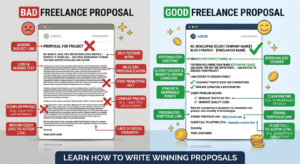
The Winning Proposal Structure
1. Personalized opening (show you read the job posting)
“Hi [Name], I saw you’re looking for someone to write blog posts about sustainable living. I’ve been following the zero-waste movement for three years and would love to help you create content that resonates with environmentally conscious readers.”
2. Demonstrate understanding of their problem
“It sounds like you need consistent, well-researched articles that drive organic traffic while establishing your brand as a trusted voice in sustainability.”
3. Briefly showcase relevant experience
“I’ve written 50+ articles on sustainability topics, and my work for [previous client or sample] resulted in [specific result if possible – or just describe the work].”
4. Propose a clear solution
“I can deliver two 1,500-word articles per week, fully researched and SEO-optimized, each including:
- Keyword research and integration
- Engaging headlines
- Properly cited sources
- Meta descriptions
- Two rounds of revisions”
5. Include a portfolio link
“You can see samples of my work here: [link]”
6. Simple, clear call-to-action
“I’d love to discuss your content goals. I’m available for a quick call this week. Does Wednesday or Thursday work for you?”
What NOT to do:
- ❌ Generic copy-paste proposals
- ❌ Starting with your life story
- ❌ Focusing on why YOU need the work
- ❌ Being overly formal or robotic
- ❌ Not addressing their specific needs
The length: 150-250 words. Long enough to show you care, short enough that they’ll read it.
Step 6: Deliver Exceptional Work
You’ve landed your first client. Now you need to deliver work that earns a testimonial and potential referrals.
Setting Expectations
Before starting work, clarify:
- Exact deliverables (what are you creating?)
- Timeline (when will it be done?)
- Revision policy (how many rounds of changes included?)
- Communication preferences (email, Slack, scheduled calls?)
Put it in writing: Even on platforms like Upwork, send a brief email summarizing the agreement before starting.
The Delivery Process
1. Communicate proactively
Don’t go silent for a week and then dump the finished project. Send updates:
- “Started working on your project today. I’ll have the first draft by Thursday.”
- “First draft is complete. Sending it over for your feedback.”
- “Based on your feedback, I’ve made the revisions. Final version attached.”
2. Deliver on time (or early)
If you said Thursday, deliver Wednesday evening. This alone makes you better than 50% of freelancers.
3. Exceed expectations slightly
- Deliver a bit more than promised (2,000 words instead of 1,500)
- Add a bonus (extra graphic, additional research, formatting improvements)
- Include a document explaining your process or recommendations
4. Make revisions easy
When sending work for review:
“I’ve attached the final files. If you need any changes, just let me know specifically what you’d like adjusted, and I’ll turn them around within 24 hours.”
5. Ask for feedback and testimonial
“I hope you’re happy with the work! I’d really appreciate your feedback. If you’re satisfied, would you mind writing a brief testimonial I can use for my portfolio? It would help me tremendously as I’m building my freelance business.”
Most happy clients will gladly provide a testimonial if you simply ask.
Step 7: Turn One Client Into Many
Your first client is just the beginning. Here’s how to build momentum.
The Follow-Up Strategy
After project completion:
Immediate (within 24 hours):
“Thank you for the opportunity to work together! I really enjoyed this project. If you need anything else related to [your service], I’m here.”
2 weeks later:
“Hi [Name], just checking in. How is [the deliverable] performing? I’d love to hear if you’re seeing results.”
1 month later:
“Hi [Name], I’ve been thinking about [their business]. Have you considered [relevant suggestion]? I’d be happy to help if you’re interested.”
The goal: Stay top of mind. When they need your service again, you’re the first person they think of.
Asking for Referrals
After a successful project:
“I’m so glad you’re happy with the work! I’m actively building my client base. Do you know anyone else who might benefit from [your service]? I’d really appreciate any introductions.”
Provide referral tools:
- Short bio they can forward
- Link to your portfolio
- Specific industries or types of clients you’re targeting
Building Your Reputation
Collect testimonials from every client:
“Would you mind writing a short testimonial about working together? Just 2-3 sentences about the results or your experience.”
Make it easy:
Provide prompts:
- “What problem were you trying to solve?”
- “How did the work help?”
- “Would you recommend me to others?”
After 5 clients, you’ll have 5 testimonials. This gives you credibility to charge more and attract better clients.
Common Beginner Mistakes to Avoid
Mistake 1: Waiting for Perfection
The trap: “I’ll start freelancing once I have the perfect website, logo, and 20 portfolio samples.”
The reality: Your first client doesn’t care about your logo. They care if you can solve their problem.
Better approach: Launch with a basic portfolio and improve as you go.
Mistake 2: Undervaluing Your Time
The trap: “I’ll charge $10/hour to be competitive.”
The reality: After taxes and expenses, you’re making $6/hour. You’ll burn out or quit.
Better approach: Charge 60-70% of market rate as a beginner, but don’t go below a livable wage.
Mistake 3: Not Having Contracts
The trap: “It’s just a small project, we don’t need a formal agreement.”
The reality: Scope creep, payment disputes, and unclear expectations destroy relationships.
Better approach: Use simple contract templates (available free online or through Upwork/Fiverr’s built-in systems).
Mistake 4: Taking Every Client
The trap: “I’m new, I can’t afford to be picky.”
The reality: Nightmare clients waste your time, damage your confidence, and prevent you from finding good clients.
Red flags to decline:
- Demanding free work upfront (beyond reasonable samples)
- Unclear or constantly changing requirements
- Pushing for unpaid “trial projects”
- Disrespectful communication
- Unrealistic budgets (“I need a full website for $50”)
Better approach: It’s okay to say no. Your time has value.
Mistake 5: Ignoring Taxes
The trap: Spending all your freelance income without setting aside tax money.
The reality: Tax season arrives with a massive bill you can’t pay.
Better approach: Immediately set aside 25-30% of every payment in a separate savings account for quarterly taxes.
For complete tax guidance, read: Self-Employed Tax Guide: Write-Offs and Deductions You’re Missing
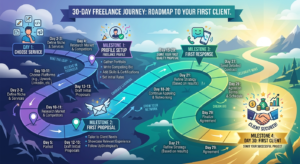
Your 30-Day Action Plan
Here’s exactly what to do in your first month to land your first client.
Week 1: Foundation
- Day 1-2: Choose your service
- Day 3-4: Create 3 portfolio samples
- Day 5: Set up basic portfolio (Notion page, Google Doc, or simple site)
- Day 6: Research pricing and set your rates
- Day 7: Create Upwork and Fiverr profiles
Week 2: Outreach
- Submit 5-10 Upwork proposals daily
- Optimize 3 Fiverr gigs
- Research 20 potential direct outreach clients
- Join 3-5 relevant Facebook groups or LinkedIn groups
Week 3: Consistent Action
- Continue submitting 5-10 proposals daily
- Send 5 personalized outreach emails to potential clients
- Engage in groups (answer questions, provide value)
- Refine your proposals based on what gets responses
Week 4: Follow-Up and Optimize
- Follow up on any conversations from weeks 2-3
- Analyze what’s working (which proposals got responses?)
- Adjust strategy based on results
- Continue consistent outreach
By day 30, most freelancers following this plan have had at least 2-3 serious conversations with potential clients, and many have landed their first paid project.
Frequently Asked Questions
Can I really freelance with no experience?
Yes. Everyone starts with zero clients. The key is starting with services that don’t require years of training (writing, social media management, virtual assistance, basic design) and being honest about your experience level while emphasizing your ability to deliver results.
How long does it take to land the first client?
If you follow a consistent outreach strategy (10+ proposals/emails daily), most beginners land their first client within 2-4 weeks. Some get lucky in the first week; others take 6 weeks. Consistency is the determining factor.
Should I quit my job to freelance?
No. Start freelancing as a side hustle while employed. Only transition to full-time freelancing once you have consistent monthly income replacing 80-100% of your salary for at least 6 months. Read: How to Start a Profitable Side Business While Working Full-Time
What if the client doesn’t pay?
Use platform protections initially (Upwork, Fiverr hold funds in escrow). For direct clients, require 50% upfront, 50% on completion. Use contracts that specify payment terms. If a client doesn’t pay despite the contract, small claims court is an option, but prevention (upfront payments, escrow) is better than cure.
How do I handle difficult clients?
Set clear boundaries upfront. Use contracts. Communicate expectations. If a client becomes abusive or unreasonable, it’s okay to refund their money and walk away. Your mental health is worth more than a single paycheck.
Conclusion: Your First Client Is Closer Than You Think
Landing your first freelance client isn’t a matter of luck—it’s a matter of process. Choose a marketable service. Create simple portfolio samples. Set strategic pricing. Reach out consistently. Write personalized proposals. Deliver great work.
The formula is simple, but it requires action. Most aspiring freelancers fail not because they lack skills, but because they don’t follow through on consistent outreach.
Your next steps:
- Choose your freelance service today
- Create 3 portfolio samples this week
- Set up your Upwork profile this weekend
- Submit your first 10 proposals by next Monday
Remember: Every successful freelancer earning $5,000, $10,000, or $20,000+ per month started exactly where you are right now—with zero clients, zero portfolio, and zero idea if it would work.
The difference between them and everyone else is that they took action.
Your first client is out there right now, searching for someone exactly like you. Go find them.
Build your freelance foundation:
- Explore multiple income streams: 25 Legitimate Side Hustles That Pay $500+ Per Month
- Build alongside your job: How to Start a Profitable Side Business While Working Full-Time
- Master your finances: Self-Employed Tax Guide: Write-Offs and Deductions You’re Missing
- Manage your money: How to Create a Personal Budget That Actually Works in 2024