Introduction
Imagine waking up to find that you made $200, $500, or even $1,000 in sales while you slept—without packing boxes, answering customer calls, or managing a warehouse. This is the promise of Amazon FBA (Fulfillment by Amazon), and for thousands of entrepreneurs around the world, it’s not a fantasy but a daily reality.
Amazon is the largest e-commerce platform on the planet, generating over $570 billion in annual revenue and serving more than 300 million active customer accounts. When you sell on Amazon, you’re not building a customer base from scratch—you’re tapping into the most sophisticated, trust-driven online marketplace ever created.Selling on Amazon FBA
Fulfillment by Amazon takes this opportunity even further. You source products, ship them to Amazon’s warehouses, and Amazon handles everything else: storage, packing, shipping, customer service, and even returns. Your role shifts from logistics manager to business strategist.
However, the reality of Amazon FBA is more nuanced than the YouTube success stories suggest. Not every product is a winner. Competition is fierce in popular categories. Startup costs can range from $500 to $5,000+. And the learning curve for navigating Seller Central, advertising, and inventory management is steep.
https://wealthytraders.online/legitimate-side-hustles/
The difference between sellers who build profitable, sustainable businesses and those who lose money comes down to preparation, research, and execution. This comprehensive guide will walk you through every step of starting an Amazon FBA business, from finding your first profitable product to scaling into a six or seven-figure operation.
For broader context on building income streams, check out: 25 Legitimate Side Hustles That Pay $500+ Per Month
What Is Amazon FBA and How Does It Work?
Before diving into strategy, let’s establish exactly what Amazon FBA is and how the entire process works.
The FBA Model Explained
Fulfillment by Amazon (FBA) is a service where Amazon stores your products in their fulfillment centers, picks, packs, ships them to customers, and handles customer service and returns for those products.
Here’s the step-by-step flow:
- You source products (either your own brand, wholesale, or retail arbitrage)
- You ship inventory to Amazon’s fulfillment center(s)
- Amazon stores your products in their massive warehouses
- A customer orders your product on Amazon.com
- Amazon picks, packs, and ships the product to the customer
- Amazon handles customer service for that order
- Amazon deposits your profits (minus their fees) into your bank account every two weeks
Why Amazon FBA Over Other E-Commerce Models
Compared to Shopify/Direct E-commerce:
- No need to drive your own traffic (Amazon has 300+ million buyers)
- Built-in trust (customers trust Amazon’s name)
- No need to build or maintain your own website
- No need to handle shipping logistics
Compared to Dropshipping:
- Higher profit margins (buying in bulk = lower unit cost)
- Better quality control (you inspect products before they reach customers)
- Faster shipping (Amazon Prime 1-2 day delivery)
- Less customer service headache
- More sustainable long-term business model
Compared to Retail Arbitrage:
- Scalable (you’re not limited by what’s on local store shelves)
- Passive once set up (products sell while you sleep)
- Brand building (you own a brand, not just reselling others)
Understanding Amazon FBA Fees
Amazon is not free. Understanding their fee structure before you start is crucial to profitability.
The Three Main Fee Categories
1. Referral Fee
Amazon charges a referral fee for every item sold, which is a percentage of the total sales price. For most categories, this is 15%, though it varies:
- Electronics: 8%
- Clothing: 17%
- Books: 15%
- Home and Garden: 15%
- Toys: 15%
2. Fulfillment Fee
This covers picking, packing, shipping, and customer service. It varies by product size and weight:
- Small standard (1 lb or less): $3.22
- Large standard (1-2 lb): $4.75-$5.40
- Large standard (2-3 lb): $5.40-$6.25
- Oversized items: $9.73+ (increases significantly with size and weight)
3. Storage Fee
Amazon charges monthly for storing your inventory:
- January – September: $0.87 per cubic foot
- October – December: $2.40 per cubic foot (holiday surge pricing)
- Long-term storage (365+ days): $6.90 per cubic foot or $0.15 per unit (whichever is greater)
The FBA Fee Calculator
Before committing to any product, run it through Amazon’s free FBA Revenue Calculator:
- Search for similar products on Amazon
- Enter your selling price and estimated costs
- The calculator shows exactly what Amazon will charge
- It reveals your estimated profit per unit
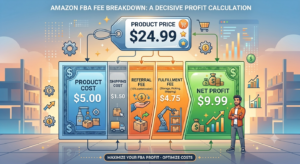
Example calculation for a kitchen gadget:
Selling price: $24.99
Product cost: $5.00
Shipping to Amazon: $1.50
Referral fee (15%): $3.75
Fulfillment fee: $4.75
Total costs: $15.00
Profit per unit: $9.99
Profit margin: 40%
Target margins: Aim for 25-40% profit margins after ALL costs. If your margins are below 20%, the product likely won’t be profitable after advertising costs.
Step 1: Product Research (The Most Critical Step)
Product selection determines 80% of your success on Amazon. A great product with mediocre marketing will outperform a mediocre product with great marketing every time.
What Makes a Winning Product
The ideal FBA product has these characteristics:
Priced between $15 and $50: Low enough that customers buy impulsively, high enough to cover fees and generate profit.
Small and lightweight: Reduces fulfillment and shipping fees. Think items that fit in a shoebox and weigh under 2 pounds.
Simple and unbreakable: Avoid electronics (returns), glass (breakage), and complex products (customer confusion, negative reviews).
Consistent demand (not seasonal): Products that sell year-round provide stable income. Avoid Christmas decorations, pool toys, or seasonal clothing.
Low competition with room for differentiation: If the first page of results is dominated by major brands with 10,000+ reviews, move on. Look for niches where page-one sellers have fewer than 500 reviews.
Good profit margins (25%+ after all fees): Use the FBA calculator to verify before committing.
Improvable: Can you make it better than what’s currently available? This is your competitive advantage.
Product Research Methods
Method 1: Manual Amazon Research
Browse Amazon categories and best-seller lists:
- Amazon Best Sellers (amazon.com/bestsellers)
- Amazon Movers and Shakers (products gaining rank quickly)
- Amazon New Releases
- Amazon Most Wished For
Look for products with:
- High sales rank (under 5,000 in main category)
- Fewer than 200 reviews on page one
- Poor quality listings (bad photos, thin descriptions)
- Complaints in negative reviews (improvement opportunities)
Method 2: Use Product Research Tools
These tools analyze Amazon data to identify profitable opportunities:
Jungle Scout ($49/month): The industry standard. Shows estimated monthly sales, revenue, competition levels, and trend data for any product.
Helium 10 ($39/month): Comprehensive suite including product research, keyword research, listing optimization, and inventory management.
Viral Launch ($69/month): Product discovery, market intelligence, and competitor analysis.
Keepa ($19/month): Tracks price history and sales rank over time, revealing seasonal patterns and demand trends.
Free alternatives:
- Amazon’s own Best Sellers list (manual research)
- Google Trends (demand trends)
- Jungle Scout’s free sales estimator
The Product Validation Process
Before ordering inventory, validate your product idea:
1. Demand verification
- Check estimated monthly sales (500+ units/month for top competitors)
- Verify consistent sales rank history (not a one-time spike)
- Confirm search volume using keyword tools
2. Competition analysis
- Count reviews on page one (fewer than 300 average = good opportunity)
- Assess listing quality (poor listings = you can compete)
- Check if major brands dominate (hard to compete with established brands)
3. Profit calculation
- Use FBA calculator with realistic numbers
- Include product cost, shipping to Amazon, packaging, and advertising costs
- Ensure 25%+ profit margin after everything
4. Supplier research
- Can you source this product at a profitable price?
- Are there reliable suppliers available?
- What’s the minimum order quantity (MOQ)?
Step 2: Source Your Products
Once you’ve identified a winning product, you need to find a reliable supplier who can manufacture it at a price that maintains your profit margins.
Where to Find Suppliers
Alibaba.com (Most Popular)
The largest B2B marketplace connecting buyers with manufacturers, primarily in China.
How to use Alibaba effectively:
- Search for your product using specific terms
- Filter by “Trade Assurance” suppliers (buyer protection)
- Look for suppliers with 3+ years on the platform
- Check verified manufacturer status
- Read reviews from other buyers
Contact 10-15 suppliers minimum. You’ll want to compare:
- Unit pricing
- Minimum order quantities (MOQs)
- Sample costs
- Production lead times
- Shipping options
- Customization capabilities
Other sourcing platforms:
- GlobalSources.com: More curated, higher quality suppliers
- Made-in-China.com: Similar to Alibaba
- ThomasNet.com: U.S.-based manufacturers
- IndiaMart.com: Indian manufacturers (often competitive pricing)
The Sample and Negotiation Process
Always order samples before placing a bulk order.
Sample ordering:
- Request samples from 3-5 suppliers
- Expect to pay $50-$200 per sample (including shipping)
- Evaluate quality, packaging, and communication
- Test the product yourself—use it, drop it, stress it
Negotiation tips:
- Never accept the first price (most Alibaba prices are negotiable)
- Mention you’re comparing multiple suppliers
- Ask for better pricing at higher quantities
- Negotiate payment terms (30/70 split is standard—30% deposit, 70% before shipping)
- Request product modifications to differentiate from competitors
Quality control:
- Hire a third-party inspection service before shipment ($100-$300)
- Companies like QIMA, SGS, or Asia Inspection verify product quality
- This small investment prevents receiving a container of defective products
Typical Startup Costs
Expect to invest $1,500-$5,000 to launch your first product:
| Expense | Cost Range |
|---|---|
| Product samples | $100-$300 |
| Initial inventory (200-500 units) | $500-$2,500 |
| Shipping to Amazon | $200-$800 |
| Product photography | $100-$400 |
| Brand logo and packaging | $50-$300 |
| Amazon Seller account | $39.99/month |
| UPC barcode | $30 |
| Initial PPC advertising budget | $200-$500 |
| Total | $1,220-$4,870 |
Step 3: Create Your Amazon Listing
Your product listing is your virtual storefront. It determines whether customers click, trust, and buy.
Listing Optimization Components
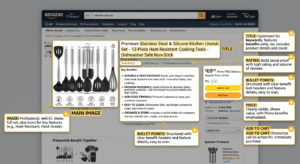
Product Title (200 characters max)
Front-load with your most important keywords while remaining readable.
Formula: Brand Name + Main Keyword + Key Feature + Size/Quantity + Color
Example:
“BrightHome Silicone Kitchen Utensil Set – 12 Piece BPA-Free Cooking Tools with Holder – Heat Resistant Non-Stick Spatulas and Spoons – Dishwasher Safe – Turquoise”
Bullet Points (5 bullets)
Each bullet should highlight a key benefit or feature, addressing customer pain points identified in competitor reviews.
Structure for each bullet:
- CAPS BENEFIT STATEMENT: Explanation of feature and how it solves a problem
Example bullets:
- 🔹 COMPLETE 12-PIECE SET: Everything you need to outfit your kitchen, including spatulas, spoons, tongs, and a convenient storage holder. Stop buying individual utensils—this all-in-one set has you covered.
- 🔹 HEAT RESISTANT UP TO 446°F: Unlike cheap plastic utensils that melt and warp, our premium silicone withstands extreme heat, making it safe for non-stick cookware and high-heat cooking.
Product Description (2,000 characters max)
Expand on benefits, tell your brand story, include additional details. Use HTML formatting for readability (bold, line breaks).
Backend Search Terms (250 bytes)
Hidden keywords that help your product appear in searches. Include synonyms, misspellings, related terms, and Spanish translations.
Product Images (Critical)
Images are the single most important element of your listing.
Image strategy:
Image 1 (Main): White background, product only. Clear, professional, high-resolution.
Image 2-3: Product from different angles, showing details and scale.
Image 4: Infographic showing features and dimensions with callouts.
Image 5: Lifestyle/in-use shot showing the product in a real-world setting.
Image 6: Before/after or comparison shot showing your product’s advantage.
Image 7 (Video): Product demonstration or brand story video (massively increases conversion).
Invest in professional photography. Budget $100-$400 for lifestyle and infographic images. This investment pays for itself many times over through higher conversion rates.
https://wealthytraders.online/start-a-side-business-while-working-full-time/
Step 4: Launch and Advertise Your Product
Your product is live. Now you need to generate sales velocity to climb Amazon’s search rankings.
Amazon PPC (Pay-Per-Click) Advertising
Amazon PPC is Amazon’s advertising platform where you pay when shoppers click on your ad. It’s the primary way to drive traffic to new listings.
Three campaign types:
Sponsored Products: Ads appear in search results and product detail pages. This is where you’ll spend 80% of your advertising budget.
Sponsored Brands: Banner ads at the top of search results. Requires Brand Registry.
Sponsored Display: Ads that follow shoppers across Amazon and even to external websites.
Launch Strategy for New Products
Week 1-2: Automatic Campaign
- Create an automatic campaign with a moderate daily budget ($20-$30/day)
- Let Amazon’s algorithm find relevant keywords for your product
- Review the Search Term Report after 7 days
- Identify profitable keywords and add negative keywords for irrelevant terms
Week 3-4: Manual Campaigns
- Create manual campaigns using profitable keywords from the automatic campaign
- Use exact match for your best-performing keywords
- Use phrase match for medium-performing keywords
- Set individual bids based on keyword profitability
Month 2-3: Optimize and Scale
- Increase bids on profitable keywords
- Reduce or eliminate spend on unprofitable keywords
- Test new keywords using broad match
- Monitor Advertising Cost of Sale (ACOS) and aim to reduce it
Target ACOS:
- Launch phase: 30-50% (investing in visibility)
- Growth phase: 20-35%
- Profit phase: 15-25%
ACOS formula: (Ad Spend ÷ Ad Sales) × 100 = ACOS%
Generating Initial Reviews
Reviews are the lifeblood of Amazon sales. New products with zero reviews struggle to convert.
Legitimate review strategies:
Amazon Vine Program: Enroll your product in Amazon Vine. Amazon sends your product to trusted reviewers in exchange for honest reviews. Cost: Free for brand-registered sellers (up to 30 units).
Request a Review button: In Seller Central, use the “Request a Review” button on every order. Amazon sends a standardized review request to customers.
Insert cards: Include a thank-you card in your packaging asking for a review. Do NOT offer incentives for reviews (this violates Amazon’s terms).
Product quality: The best review strategy is delivering an exceptional product that customers want to talk about.
Never buy fake reviews. Amazon’s detection systems are sophisticated and will suspend your account permanently.
Step 5: Scale Your Amazon FBA Business
Once your first product is profitable, it’s time to scale.
The Product Expansion Strategy
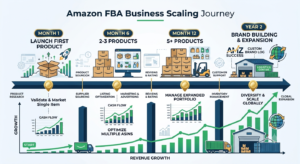
Launch a second product within 60-90 days of your first product becoming profitable.
Product line expansion approaches:
Complementary products: If you sell kitchen utensils, add cutting boards, pot holders, or storage containers.
Variations: Offer your existing product in different colors, sizes, or quantities.
New categories: Move into adjacent categories where you can leverage your existing brand.
The portfolio approach:
Successful Amazon sellers typically have 5-15 products generating revenue. One product can be risky (algorithm changes, new competitors, supply issues). Multiple products spread risk and create compounding growth.
Brand Building on Amazon
Amazon Brand Registry:
Register your brand with Amazon to unlock:
- Sponsored Brands advertising
- A+ Content (Enhanced Brand Content)
- Brand Store (custom multi-page storefront)
- Brand Analytics (search data and insights)
- Protection against counterfeiters
A+ Content:
Enhanced product descriptions with rich media, comparison charts, and brand storytelling. A+ Content can increase conversions by 5-10%.
Amazon Brand Store:
Create a free multi-page storefront showcasing your entire product line. This serves as your “website” on Amazon and can be used in advertising campaigns.
Inventory Management
Running out of stock is one of the most costly mistakes on Amazon. You lose sales momentum, search rankings, and customer trust.
Inventory planning:
- Track your daily/weekly sales velocity
- Account for supplier production time (usually 2-4 weeks)
- Account for shipping time (sea freight: 4-6 weeks, air freight: 7-14 days)
- Account for Amazon receiving time (7-14 days)
- Maintain 30-60 days of inventory at all times
Inventory formula:
(Daily sales × Lead time in days) + Safety stock (14 days) = Reorder point
Example: If you sell 10 units/day and your lead time is 60 days:
(10 × 60) + (10 × 14) = 740 units reorder point
Tools for inventory management:
- Helium 10 Inventory Management
- RestockPro
- SoStocked
https://wealthytraders.online/gig-economy-guide/
Common Amazon FBA Mistakes to Avoid
Choosing a Product Without Proper Research
The mistake: Picking a product you personally like rather than one backed by data.
The reality: Your personal preference doesn’t matter. Market data matters.
The fix: Use research tools, validate demand, calculate margins, and assess competition BEFORE ordering inventory.
Underestimating Total Costs
The mistake: Only counting product cost and Amazon fees while ignoring advertising, samples, photography, packaging, and returns.
The reality: True cost of goods includes everything from factory to customer.
The fix: Create a complete cost spreadsheet including ALL expenses before committing to a product.
Neglecting Product Photography
The mistake: Using supplier photos or smartphone pictures.
The reality: Images are the #1 conversion factor on Amazon. Poor photos equal poor sales.
The fix: Invest in professional photography. Budget $100-$400 minimum. This is not optional.
Ignoring Cash Flow
The mistake: Spending all revenue without accounting for reorder costs.
The reality: Amazon pays every 14 days. But you need to reorder inventory weeks before your current stock runs out. This creates cash flow gaps.
The fix: Reinvest 30-50% of profits back into inventory for at least the first year. Maintain a separate business savings account.
Price Wars
The mistake: Competing solely on price in a race to the bottom.
The reality: You can’t win a price war against Chinese factories selling direct.
The fix: Differentiate through better quality, improved design, superior packaging, bundled products, or enhanced brand experience. Compete on value, not price.
Violating Amazon’s Terms of Service
The mistake: Buying reviews, manipulating rankings, creating fake accounts, or violating category restrictions.
The reality: Amazon will suspend or permanently ban your account. They rarely give second chances.
The fix: Play by the rules. Read Amazon’s Seller Policies thoroughly. When in doubt, don’t do it.
Tax and Financial Management for Amazon Sellers
Running an Amazon FBA business means you’re a business owner with tax obligations.
Sales Tax Compliance
Amazon now collects and remits sales tax in most U.S. states through Marketplace Facilitator laws. However, you still need to understand your obligations:
- Amazon handles sales tax collection in most states
- You may need to register for a sales tax permit in your nexus states
- Some states have additional business registration requirements
Income Tax Obligations
Your Amazon FBA profit is taxable income.
Track all expenses:
- Product costs and shipping
- Amazon fees (referral, fulfillment, storage)
- Advertising costs
- Software subscriptions
- Photography and design
- Business travel and education
Estimated taxes:
If you expect to owe $1,000+ in taxes, make quarterly estimated payments:
- April 15, June 15, September 15, January 15
Recommended: Work with a CPA experienced in e-commerce businesses. The cost ($500-$1,500/year) is easily recovered through proper tax planning.
For comprehensive self-employment tax guidance, read: Self-Employed Tax Guide: Write-Offs and Deductions You’re Missing
Frequently Asked Questions
How much money do I need to start Amazon FBA?
A realistic minimum is $2,000-$5,000 for your first product, including inventory, shipping, photography, advertising, and Amazon fees. Some sellers start with $1,000 by choosing very low-cost products with small initial orders, but higher investment generally leads to faster success and better margins.
How long before I make a profit?
Most Amazon FBA sellers see their first sales within 2-4 weeks of launching. However, profitability typically takes 3-6 months when factoring in initial inventory investment and advertising costs. Some products break even in the first month; others take longer.
Do I need an LLC to sell on Amazon?
No, you can start as a sole proprietor. However, forming an LLC is recommended for liability protection once you’re selling regularly. An LLC separates your personal assets from business liabilities. Most states allow you to form an LLC for $50-$500.
Can I sell on Amazon from outside the United States?
Yes. Amazon operates marketplaces in the U.S., Canada, UK, Europe, Japan, Australia, and more. International sellers can register and sell on any marketplace. You’ll need a valid bank account that can receive payments in the marketplace’s currency.
What is Amazon Brand Registry and do I need it?
Brand Registry is Amazon’s program to protect registered trademarks. It’s not required but highly recommended. Benefits include A+ Content, Brand Store, Sponsored Brands ads, and protection against counterfeiters. To enroll, you need a registered trademark (or pending application through Amazon’s IP Accelerator program).
Is Amazon FBA still profitable in 2024?
Yes, but it’s more competitive than ever. The days of throwing any random product on Amazon and making easy money are over. Success requires proper research, quality products, strong listings, and strategic advertising. Sellers who approach it as a real business—not a get-rich-quick scheme—can build highly profitable operations.
Tools and Resources for Amazon Sellers
Essential Software
Product Research:
- Jungle Scout ($49/month) – Product database, sales estimates, keyword research
- Helium 10 ($39/month) – Comprehensive suite for product research and optimization
Listing Optimization:
- Helium 10 Scribbles – Keyword-optimized listing creation
- Canva (Free) – Infographic and lifestyle image creation
- Jungle Scout Listing Builder – AI-assisted listing creation
PPC Management:
- Perpetua ($250/month) – Automated PPC optimization
- Pacvue ($500/month) – Enterprise-level PPC management
- Amazon’s Campaign Manager (Free) – Basic but functional
Inventory Management:
- RestockPro ($59/month) – Inventory planning and forecasting
- SoStocked ($79/month) – Advanced inventory management
Accounting:
- QuickBooks ($30/month) – General business accounting
- TaxJar ($19/month) – Sales tax compliance
Educational Resources
Free:
- Amazon Seller University (official Amazon training)
- YouTube channels: My Amazon Guy, Jungle Scout, Helium 10
- Reddit r/fulfilledbyamazon community
- Amazon Seller Forums
Paid:
- Amazing Selling Machine ($997) – Comprehensive course
- Marketplace Superheroes ($997) – International selling focus
- Freedom Ticket by Helium 10 (included with subscription)
Conclusion: Your Amazon FBA Journey Begins Now
Amazon FBA represents one of the most accessible and scalable business opportunities available today. The barrier to entry is relatively low, the infrastructure is world-class, and the customer base is unmatched.
However, success requires treating this as a real business, not a side experiment. Proper product research, quality sourcing, professional listings, strategic advertising, and careful financial management are the pillars of a profitable Amazon operation.
Your action plan:
Week 1-2: Research
- Choose your niche and begin product research
- Use Jungle Scout or Helium 10 to validate demand
- Calculate complete profitability using FBA calculator
Week 3-4: Source
- Contact 10-15 suppliers on Alibaba
- Order samples from top 3 suppliers
- Begin designing packaging and branding
Week 5-8: Prepare
- Place inventory order
- Create your Amazon Seller account
- Set up Brand Registry (if applicable)
- Arrange product photography
Week 9-10: Launch
- Ship inventory to Amazon
- Create optimized product listing
- Launch automatic PPC campaign
- Begin requesting reviews
Week 11-12: Optimize
- Analyze PPC data and create manual campaigns
- Monitor reviews and address customer feedback
- Begin planning your second product
The opportunity is real, but so is the work required. Sellers who commit to learning, testing, and optimizing will find that Amazon FBA can be genuinely life-changing—not just as a side income, but as a scalable business that can replace a full-time salary and beyond.
Expand your financial knowledge:
- Explore more income streams: 25 Legitimate Side Hustles That Pay $500+ Per Month
- Build alongside your job: How to Start a Profitable Side Business While Working Full-Time
- Master gig work: Gig Economy Guide: Making Money with Uber, DoorDash, and More
- Start freelancing: Freelancing for Beginners: How to Land Your First Client
- Optimize your taxes: Self-Employed Tax Guide: Write-Offs and Deductions You’re Missing
- Manage your money: How to Create a Personal Budget That Actually Works in 2024